


Freeriding at the Dachstein


Feel the Freedom and Experience the Powder
at the Dachstein Glacier
Freeriding on the Dachstein combines high-alpine scenery with a sporting challenge. All around the Dachstein, you’ll find a variety of runs for anyone who wants to hit the deep snow on the Dachstein. Especially when there’s fresh snow, the powder on the Dachstein Glacier is at its most impressive.
Off the slopes, good preparation is key
Safety and Equipment
You are in an open ski area and in high-alpine terrain. You proceed at your own risk.
The fact that individual access points or routes have been cleared does not guarantee safe conditions along the entire route. Snow, wind, visibility, and avalanche conditions can change rapidly.
Therefore, before every tour, check the current weather and route conditions as well as the current avalanche situation. Observe closures, signage, and all local notices on-site.
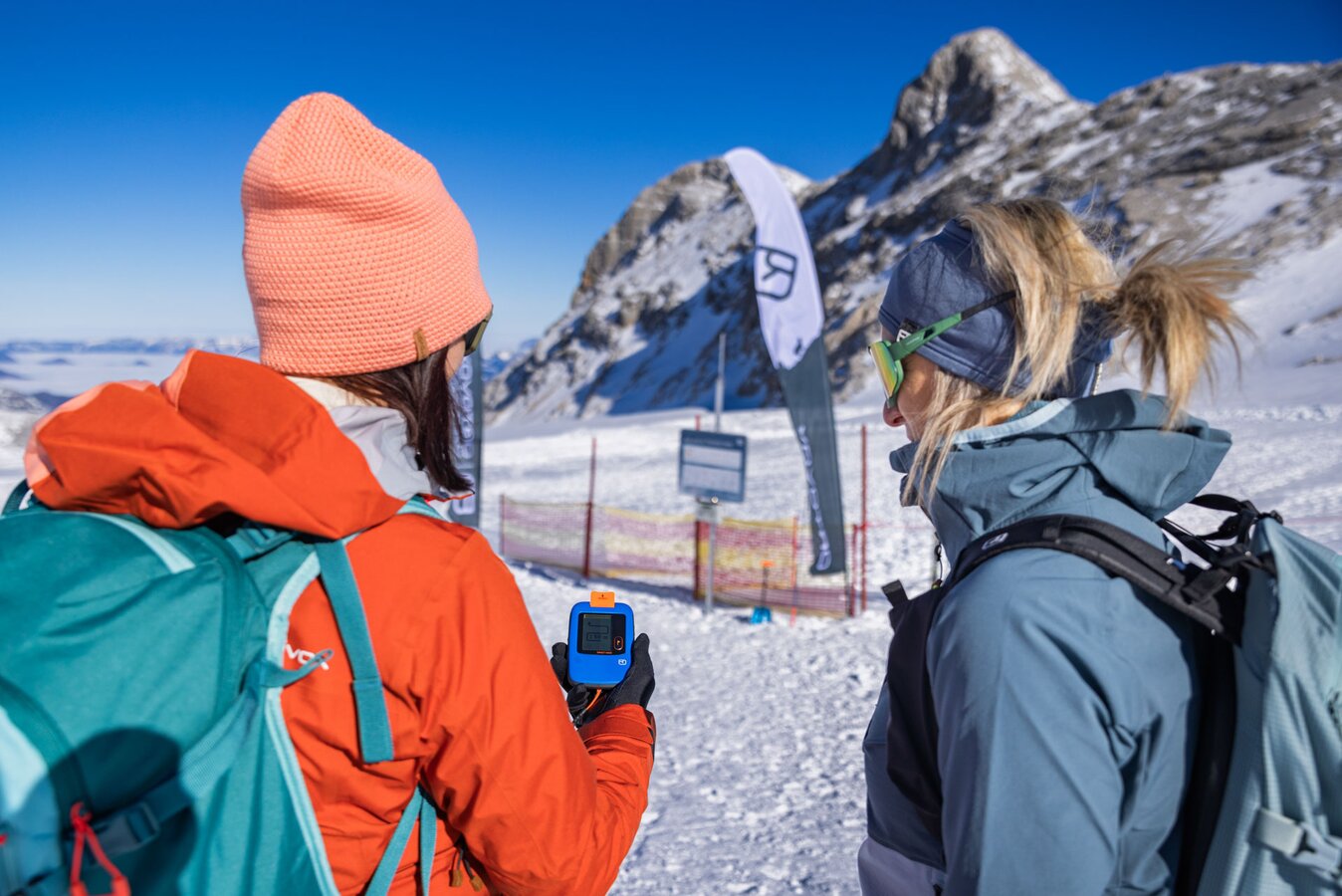
The Right Gear for Your Freeride Adventure
Plan your route carefully, tailor it to your skill level, and find out about the conditions in the area. If you have little experience in high-alpine terrain, you should be accompanied by a mountain or ski guide who knows the area well.
Standard safety equipment for every tour includes:
- Avalanche transceiver
- Shovel
- Probe
- First-aid kit
- Cell phone
- GPS app
- Depending on conditions, a climbing harness, via ferrata set, crampons, and a short rope may also be useful.
31 Entrance to the Rosmariestollen
Route Description
Our team checks the Rosmariestollen daily and opens it when conditions are right.
You can reach the entrance on the north side via a ladder that’s about 30 meters long. A climbing harness and via ferrata set are recommended for self-belaying. The length of the ladder also illustrates the glacial retreat of the past decades: About 30 years ago, the tunnel entrance was only a few meters above the snow. Today, the ladder must be regularly extended further down.
At the southern exit of the tunnel, you’ll emerge directly onto the exposed southern slopes of the Dachstein. This is where the approximately 150-meter-long traverse to Edelgrieß begins. The exposed trail is marked and secured with a fixed rope. Here, too, it’s recommended that you secure yourself with a via ferrata set. Depending on conditions, crampons may also be necessary.
32 Edelgrieß
Route Description
One of the most famous freeride routes in the Eastern Alps: The Edelgrieß combines spectacular high-alpine terrain with a long descent of up to 1,400 meters in elevation —without any significant ascents. The route is located on the southern slopes of the Dachstein and is accessed via the Rosmariestollen. Depending on snow and weather conditions, you can expect long deep-snow or firn descents, as well as various alternative routes. A reliable assessment of the avalanche conditions and excellent skiing technique are essential.
From the Dachstein mountain station, you’ll first ski down to the Austriascharte east of the Hunerkogel. This is followed by a short ascent, during which you’ll attach your skis to your backpack. You’ll then reach the approximately 30-meter-long ladder leading to the Rosmariestollen. A climbing harness and via ferrata set are recommended for self-belaying. Depending on conditions, our team will open the tunnel and clear the snow from it. At the southern exit of the tunnel, you’ll emerge directly onto the exposed southern slopes of the Dachstein. The approximately 150-meter-long traverse to the Edelgrieß is marked and secured with a fixed rope. Depending on conditions, crampons are recommended. Also, use the via ferrata set and secure yourself to the rope.
At the end of the exposed traverse, strap on your skis. Depending on the condition of the snow cornice, the descent into the Edelgrieß is either direct or requires additional safety measures. Further along, the cirque curves slightly to the right. Depending on the season, snow conditions, and weather, you’ll find deep snow or firn slopes here. When exiting the Edelgrieß, you have two options: You can traverse to the right toward the Türlwandhütte and continue to the valley station of the Dachstein Glacier Cable Car, or you can keep to the left at the Jungfrauensteig and ski another 700 meters of elevation gain over the Kramllahn down to Ramsau.
33 Schwadrinn
Route Description
The Schwadrinn is one of the best-known and most challenging steep gullies on the Dachstein.
It leads directly into the cirque below the Hunerkogel and the Dachstein Glacier Cable Car. Access is via the Rosmariestollen.
This route requires excellent skiing skills, extensive alpine experience, and careful trip planning.
Navigating the route is challenging, and its accessibility depends heavily on snow, weather, and avalanche conditions.
For this route, we strongly recommend being accompanied by a mountain and ski guide familiar with the area.
34 Gamsfeld
Route Description
The Gamsfeld is one of the major high-alpine runs on the Dachstein.
You can reach the route either by ascending or via the Rosmariestollen and the Edelgrießhöhe. The entire descent covers just under 1,400 meters in elevation, leading all the way down to Ramsau.
This run requires excellent skiing skills, extensive alpine experience, and careful trip planning.
Navigating the route is challenging, and its accessibility depends heavily on snow, weather, and avalanche conditions.
For this route, we strongly recommend being accompanied by a mountain and ski guide familiar with the area.
35 Gruberscharte
Route Description
The Gruberscharte is one of the most beautiful freeride routes on the Dachstein for very skilled skiers. Short ascents, high-alpine terrain, sweeping views, and a long descent all the way down to Ramsau make this route particularly varied. The approach leads via the Rosmariestollen and the Edelgrießhöhe to the Gruberscharte. From there, the long descent begins through the Gruberkar down to the Gasthof Feisterer. For this route, you’ll need excellent skiing skills, alpine experience, good physical conditioning, and careful trip planning. Skiing this route is only recommended when snow, weather, and avalanche conditions are suitable!
From the Dachstein mountain station, you’ll first ski down to the Austriascharte east of the Hunerkogel. This is followed by a short ascent, during which you’ll attach your skis to your backpack.
You’ll then reach the approximately 30-meter-long ladder leading to the Rosmariestollen. A climbing harness and via ferrata set are recommended for self-belaying.
At the southern exit of the tunnel, you’ll emerge directly onto the exposed southern slopes of the Dachstein. The approximately 150-meter-long traverse to the Edelgrieß is marked and secured with a fixed rope. Depending on conditions, crampons are recommended. Also use the via ferrata set and secure yourself to the rope.
At the end of the traverse, strap on your skis. Depending on the condition of the snow cornice, you’ll either ski down directly or with additional belaying. Afterward, traverse across the Edelgrieß Glacier toward Edelgrießhöhe.
For the next short climb, you can use skins or carry your skis on your backpack. From the Edelgrießhöhe, keep to the right, crossing below the Gamsfeldspitze and past the Scheichenspitze until you reach the entrance to the Landfriedtal.
From there, ski keeping more to the left until just below the Gruberscharte. The final 60 meters of elevation gain to the saddle are covered on foot.
At the Gruberscharte, the descent into the Gruberkar begins. Depending on conditions and the current avalanche situation, the route tends to run more to the right through the cirque. Further down, the forest gradually becomes denser. The route finally ends in the area of the Feisterer Lift.
For this route, we strongly recommend being accompanied by a mountain and ski guide familiar with the area.
36 Fluder
Route Description
The Fluderrinne is one of the most challenging high-alpine freeride routes on the Dachstein.
You can reach it via the Rosmariestollen and the Edelgrießhöhe. The route runs from the Gamsfeldspitze to Ramsau. At the end of the Fluderrinne, the descent is interrupted by a rappelling section. This makes the tour particularly technically demanding and suitable only for very experienced freeriders.
Completing this route requires excellent skiing skills, extensive alpine experience, and very careful trip planning. Navigating the route is extremely difficult, and its skiability depends heavily on snow, weather, and avalanche conditions.
You will be skiing in open terrain and high-alpine areas. You ski at your own risk. Before your tour, check the current route status, weather and snow conditions, and avalanche conditions, and be aware of local closures and warnings.
For this route, we strongly recommend being accompanied by a mountain and ski guide familiar with the area.
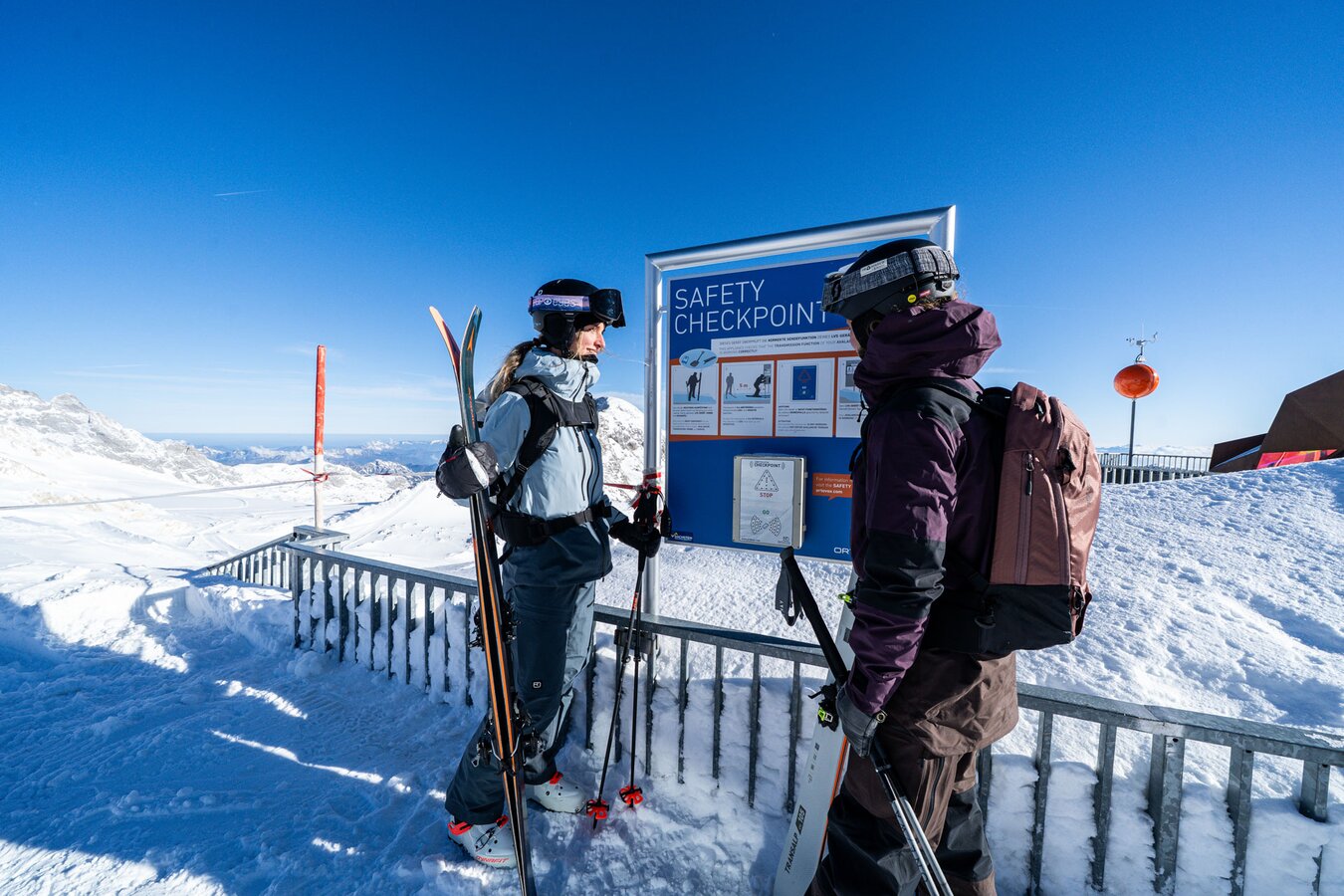
Avalanche Transceiver Checkpoint
With the avalanche transceiver checkpoint near the Dachstein mountain station, you can check whether your avalanche transceiver is transmitting. A visual and audible signal provides immediate feedback. For ski tours and freeride excursions in open terrain, a functioning avalanche transceiver, probe, and shovel are essential safety equipment. Checking your gear before you set out helps you ensure it’s in working order - but it doesn’t replace the necessary experience and proper handling of the equipment.


